
Continued from yesterday’s post. Also some editorial stuff here. Ugh, I misspelled “cocktail” right in the title. Sometimes you’ve got to pay better attention, old timer. I actually misspell stuff quite a bit as I’m rushing to get these puppies out in the morning. Jo usually points them out to me. But “cockail?” Yeesh. I beat myself up about these pretty hard. I do not like grammatical errors in print. But, unlike receiving a bad meal or cockail (cocktail), I can at least go back and fix it. I also changed the title from “Young Man’s Game” to “Young Person’s Game.”
I woke this morning thinking about this. Just when did the egg white enter into the cocktail world and over take the sour? If you read yesterday’s post, it’s pretty easy to figure out that a “flip,” what we refer to today as anything with an egg, was a very different, very weird beast. But the sour remained pretty much the same. Booze, sugar, citrus.
I asked Google. This site here tells us, “Egg whites in cocktails were officially put into the mainstream when bartending-forefather Jerry Thomas published his recipe for the classic whiskey sour in 1862’s bartenders guide How to Mix Drinks or The Bon Vivant’s Companion.” Well, after reading the cocktail book, we know this to be false. Sorry, Demitri but it’s pretty obvious you didn’t do your homework. The whiskey sour isn’t even in the damn book. The internet isn’t always right, kiddos.
Okay, onto the next. This dude, the Alcohol Professor, who seems to have a pretty good grasp of cocktail history and has a great website dedicated to all things cocktail but he or she is still unable to pinpoint the exact time the egg white entered the cocktail scene and describes it thus:
“Eggs were added to cocktails during the Golden Age of Cocktails in the late 19th century, but there was not much deviation from eggnog. The Egg Flip was mentioned by many bartending books (a throwback to colonial America), and William T. “Cocktail” Boothby introduced the world to the Egg Lemonade (which does not have lemon juice in it). It was also at this time that the whites began to be separated for cocktails.”
Ok. Again, there’s no specific mention of date, time, people, etc. We also know the very last line to be untrue.
Next.
This website, The Vine Pair, basically says the same thing as Mr. Demitri:
“Fast-forward to a classic egg white cocktail like the whiskey sour, which first appeared in Jerry Thomas’s Bartender’s Guide in 1862 and was basically egg white, simple syrup, lemon juice, and whiskey. (Notice this contains nothing of the sour mix most whiskey sours are adulterated with these days.) And then there’s the Pisco Sour, which was (probably?) invented in the early 20th Century. See? No reason to be afraid. Egg whites have been mingling with booze for centuries.”
Nope. Guess again. I’m wondering why everyone is spreading false information about Mr. Thomas. I’m now going to triple check my reference (I’ve got a copy of the book right by my side).
Here we go:

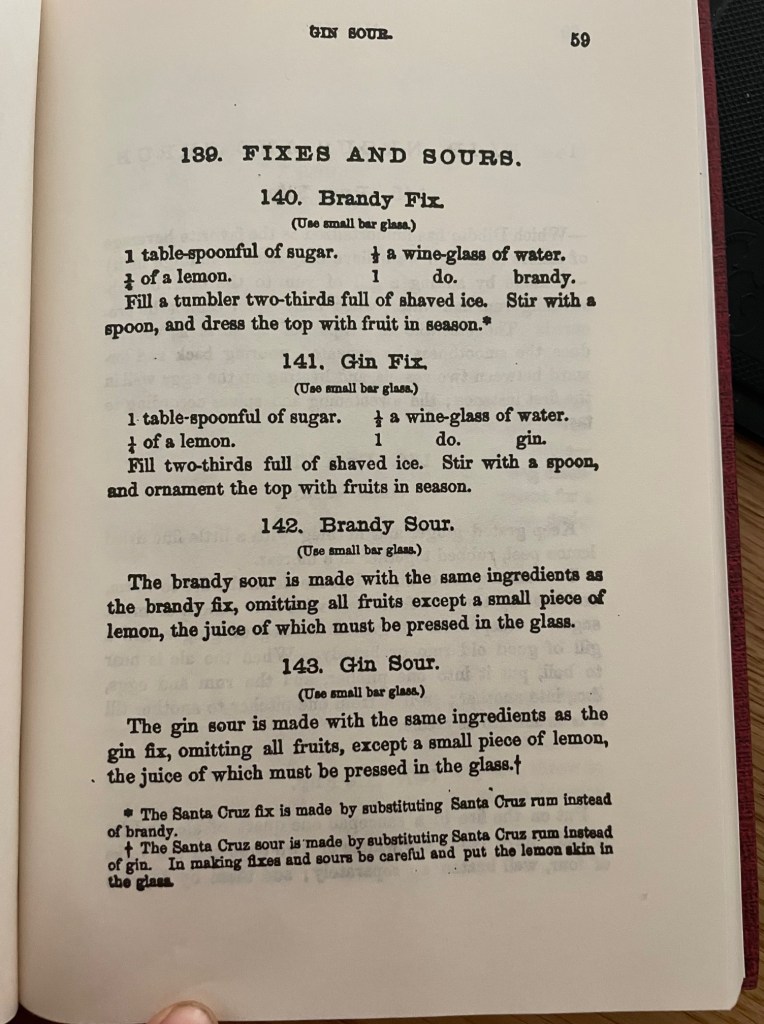
As we can see, I’m not crazy, in the table of contents and the one page dedicated to sours there is no mention of the whiskey sour everyone is speaking of. If I’m missing something, please tell me. I’m thinking maybe people just assume the common whiskey sour was in this book?
So, back to the drawing board. Maybe Punch.com? Ugh. Let’s go…
Nope. This article on Punch says the same damn thing:
“The first printed record of the Whiskey Sour appears in 1862 in Jerry Thomas’ How to Mix Drinks, though the recipe likely dates back many years earlier. Relying on sugar to be dissolved in a small amount of water before adding the remaining ingredients, rather than syrup, the original Whiskey Sour construction resembles that of punch. But unlike punch, the Whiskey Sour has always been made on a small plan, a fact that makes it difficult to pinpoint the drink’s precise origins.”
By 1870, however, its popularity was well enough established that it required no explanation when printed in a feature in the Waukesha Plaindealer, a Waukesha, Wisconsin, newspaper. Indeed, as David Wondrich observes in Imbibe!, at the peak of its popularity between the 1860s and the 1960s, the Whiskey Sour “was one of the cardinal points of American drinking, and… one of the few drinks that could come near to slugging it out with the vast tribe of cocktails in terms of day-in, day-out popularity.”
While the original three-ingredient cocktail is still the best-known version, other early renditions of the drink have since gone on to become classics in their own right, from the red wine-topped New York Sour to the frothy Boston Sour, made with egg white—a PUNCH favorite. From there, many of today’s bartenders have contributed simple riffs to the canon. Switching up flavors via the additions of liqueurs and nontraditional sweeteners results in a wide variety of Whiskey Sours, though most of them still hew closely, at least in construction, to the original template.”
Unless I’m crazy, all these sources are getting this wrong. But if you read the above, we do have a lead. The Boston Sour. Huzzah. We may have found it.
I consulted Google and it told me the first appearance of the Boston sour is from the 1892 book The Flowing Bowl by one William Schmidt. Here’s the .pdf version if you want to take a looksee (scroll to page 12 to see a picture of the man and his fantastic mustache). But waitagoddamminute. I can’t find a damn Boston sour anywhere in there. Look for yourself. There’s an index. The sours chapter starts on page 124. Ugh. Another false lead. I’m starting to feel a little crazy here. Every source points to Jerry Thomas. Not everyone got it wrong did they? I can’t be right. I don’t know…I’ve flipped through the book several times trying to find the mention of a whiskey sour and just can’t. Maybe my version is inaccurate?
At any rate, The Flowing Bowl does have many drinks with “the white of an egg.” So we’re getting closer. On another note, this book has some great old recipes in it with great names such as The Morning Delight, The Nap, The Reliever, and one with green chartreuse called, The Evening Sun.
Again, I’m wondering where this is all going wrong. I can’t possibly be right when all these other sources are saying the same thing. The only explanation is that Google is wrong. If you type “History of the whiskey sour” the Google explanation comes up with Jerry Thomas. Typing “History of the Boston sour” conjures the William Schmidt reference. My guess is that the people writing these articles used the Google version as the standard but didn’t consult the actual books themselves. I don’t know anymore. Sigh. I’ll give it one more shot.
There’s a great site with the entire lineage of the early cocktail books with links to all the .pdfs. Yeah, pretty cool. Here it is. In case you’re wondering, yes, I did skim through the second edition of How to Mix Drinks or The Bon Vivant’s Companion (1876) and still no whiskey sour reference.
Lot’s of work here. I went straight to the book from 1900, Harry Johnson’s Bartenders’ Manual or How to Mix Drinks in the Present Style. First off, ha, Harry Johnson. Yes, he’s got a whiskey sour recipe. Yes, it’s real weird. No, there’s no egg white in it and finally, no, there’s no mention of a Boston sour anywhere. The book is pretty cool to read however, and has chapters in the beginning like “How a Bartender May Obtain a Situation.” It’s worth a look.
Ok, so let’s get into the 20th century.
Stuarts Fancy Drinks and How to Mix Them (1904) by Thomas Stuart mentions a Boston Egg Nog that has nothing to do with any modern sour and the whiskey sour here (page 67) is still absent of an egg white. Let’s keep going.
The 1917 Recipes for Mixed Drinks by Hugo R. Ensslin mentions no Boston Sour and again, has the same whiskey sour recipe as the others, sans egg white.
One more before I quit and do this all again tomorrow. It’s already 10.
I went all the way to the end for a mild discovery. We’ve got a book here, The U.K.B.G. Guide to Drinks, 1953. Page 154, a small blurb on sours:
Brandy Sour, Gin Sour, Rum Sour, Whisky Sour
Juice of 1/2 Lemon. 1/2 teaspoonful of Sugar. 2 oz. of spirit desired. Shake well and strain into glass. Syphon Soda on top. Add slice of Lemon. (A few drops egg white improves all sours but is not an ingredient of original recipe.)
Ok. That’s the first mention I’ve found so far. Nothing else before then.
If there’s anyone out there who can help, I’d appreciate it, as this, along with everyone else getting it wrong, is now occupying my mind. I’m also thinking I just glossed over something and missed it.
More tomorrow?
 The Aging Bartender
Leave a comment