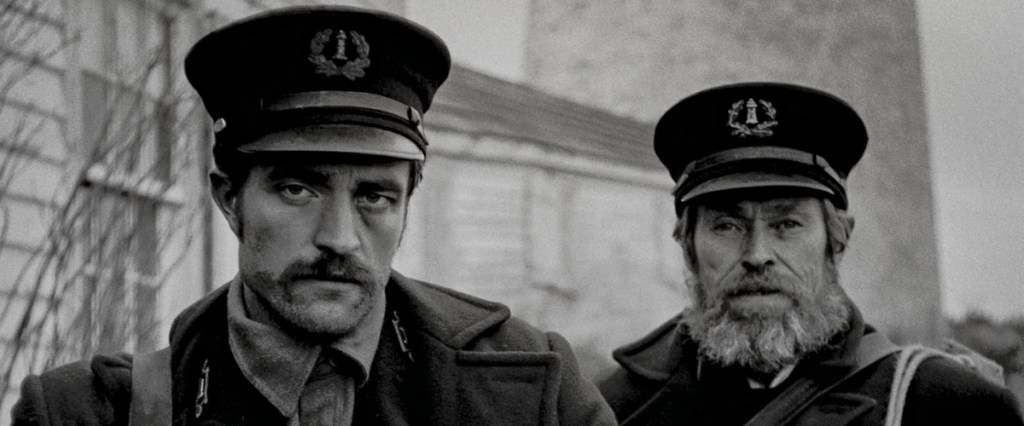
There’s certain movies that are tailor made for a sick son of a bitch like myself. The Lighthouse is one of those movies. The sophomore production from the outstanding and twisted writer/director Robert Eggers, whose first movie was The Witch–a terrifying slow burn about a puritan family scraping away an existence in the woods back in 1630s New England while under the influence of the devil himself. Eggers’ modus operandi thus has been nailing the dialects and speech patterns from bygone eras in which he chooses to carve a fantastical slice from, and placing said characters into genre horror landscapes. The Lighthouse is no different, but after a current rewatching, I find it more darkly comic and beautiful.
This time around, we’re in the 1890s, but still in New England, and we’ve got just two actors with us for the entirety of the film, Willem Defoe and Robert Pattinson. Defoe as the gnarled lighthouse keeper and Pattinson as the new guy, the babe in the woods archetype.
The film is rife with the patois of that time period. From Dafoe, it’s more of a older, seafaring form reminiscent of passages in Moby Dick. From Pattinson it seems more akin to dialogue spoken by interior New Englanders of that era, apropos considering his character had spent most of his life and time inland working various tough jobs such as logging.
After a quick introduction to the scene and setting the two men sit down to eat their first of many meals together and Dafoe’s character, Thomas Wake, delivers a toast:
Should pale death with treble dread
Make the ocean caves our bed,
God who hear’st the surges roll,
Deign to save our suppliant soul.
This moment sets the stage for the entirety of the film. Pattinson’s Ephraim Winslow refuses the rum toast, as he’s been told there’s no drink allowed while at the lighthouse, but Wake, being a traditionalist, becomes irritated at the snub as well as the insolence toward his authority which he feels overrides the written rules. This sets up the power struggle that continues for the rest of the movie with Wake as the unforgiving taskmaster and Winslow as the donkey. While Winslow toils, Wake is upstairs in the apex of the lighthouse, locked away, but anytime Winslow fails or falters, Wake is there to chastise him. It creates a dark, but comedic dynamic that is all the sweeter due to the unreal dialogue once you become accustomed to it. I do have to admit, it took a second viewing to be able to gather all the gems the writing had to offer. The discourse and vernacular between the two men is that good and performed so well.
As the relationship between the lighthouse keepers begins to heat up, we start to see more of the unraveling of the characters as they get to know each other’s personal histories better during bouts of intense rum drinking which lead to crazier hijinks and only serve to give the character’s ammunition against one another once the isolation and cabin fever start to kick into overdrive. The cold, wet, and unforgiving weather serves as a tertiary character as it sets off events the two men have no choice but to endure.
The cooler part of the flick, to me, is the flights of fancy from the point of view of Winslow. We’re not really sure if it’s real or hallucination, but from the get go, he’s prone to seeing nautically themed sailor’s myths, such as mermaids, in and around the rock he’s chosen to work on. The confinement is not good for him, and neither is the drink as it only serves to bring his personal demons closer to the fore and in my interpretation, banish him, at the end, to his fate which is a personal, Promethean hell.
For those who enjoy movies rife with symbolism, myth, great acting, and archaic speech, this one is for you. It should also be said this was filmed in black and white and in a tight aspect ratio of 1.19:1 to make the spaces in the scenes appear even more confining. Enjoyable for those who would like to be more challenged with what they view but not something you can easily kick back and watch if you want to shut your brain off and be more simply entertained.
 The Aging Bartender
Leave a comment