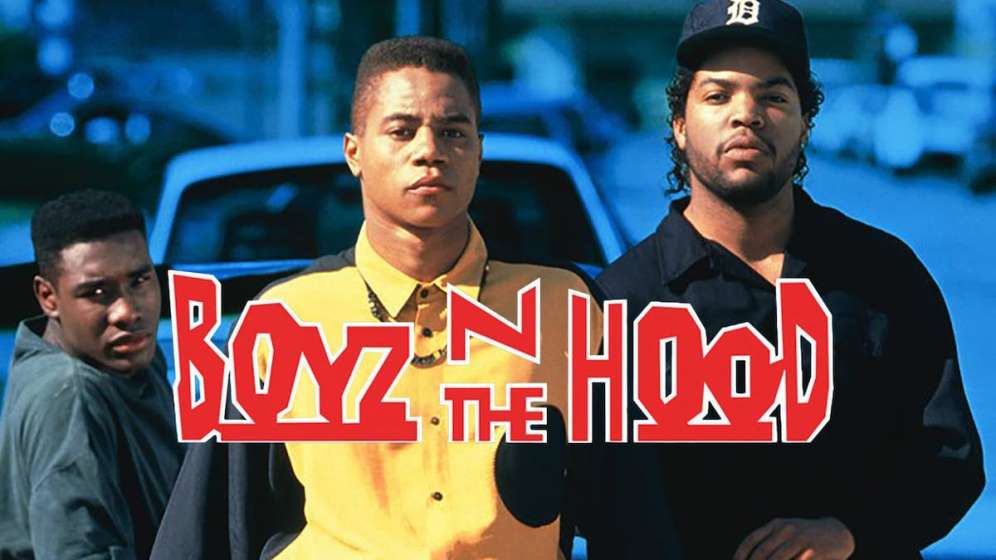
Watching Boyz n the Hood as an upper middle class, middle aged white male, instead of a privileged white suburban teenager, was an entirely different experience but probably not why you think. Back when the movie was released in 1991, it provided a glimpse of life in a place most people in the U.S. and the world had no idea even existed except maybe in gangsta rap from that era from such bands as N.W.A. Yes, my friends and I in those days wore our jeans baggy with our boxer shorts hanging out and quoted this flick endlessly while blasting Easy E and driving our parent’s cars around. It should also be noted there were no black people in my high school until my senior year when a couple of guys transferred up from New York. Vermont was a very white place then and still is.
The part of this movie that hit home the most on a recent rewatch after three decades was not the striking disparity of life in South Central, Los Angeles compared to my own in South Burlington, Vermont, (something I thought was cool as a teenager) but the scenes with the powerful performance of Laurence Fishburne as the father of Trey. In a place where many kids did and still do not have proper father figures–a statistic which is extremely detrimental to the development of all young women and men–he stood out to me as the big game changer to just one life in the movie where most of the fathers were absent.
All these years later the movie does a great job of showing, not telling. Fishburne’s character, Furious Style, imparts much wisdom to his son, much of it real world knowledge pertaining to sex, education, and how to be an upstanding citizen while surrounded by a place so hard to get out of, that most male teenagers have to turn to either sports or crime in order to make something of themselves, the latter of course being the reason why so many young black men were murdered in those days and still are.
Reading between the lines, we see Furious Styles’ limitations, however, as he attempts to bring up his son in a difficult world but refuses to remove both of them from said life. He chooses to remain in such a place when it appears he may have been able to get out if he wanted to, or at least allowed his son to go to a better neighborhood with his mother. This, to me, is the most important piece of the movie because as a father I find I want to change the narrative and lessons handed to me by my own father, but also sometimes now realize why he did certain things in order to protect me from myself. Teenage boys, are, after all, complete idiots. Children in “men’s” bodies pumped up by an insane amount of testosterone who think they know everything when they don’t know shit from shinola. An awful combination in a place rife with violence with gangs, guns, drugs, etc.
The most poignant scene, to me, is when Furious takes his son and a friend to Compton and explains to them how other races help themselves and how the government purposely has kept certain neighborhood, and people, poor. for example, and not to get too political here, but most cocaine imported into the United States in the 80s and 90s was set up by the C.I.A., Reagan, Bush senior, and Bill Clinton, through, you guessed it, Arkansas. There’s plenty of literature about it and some deny while some can simply connect the dots. Bush senior = former head of the C.I.A. Clinton = former governor of Arkansas. Reagan = well, god..His wife created D.A.R.E. which only propelled the continuation of Nixon’s war on drugs, a policy that not only jump started our country as a police state but also created massive violence in Central America that continues to this day.
The hardest part about watching this movie is knowing things have stayed the same. The poor neighborhoods in cities are still an awful place for kids to grow up. All these years later and these areas still have high crime, terrible education, and drug problems. The black male homicide rate has gone down since it’s peak in the 90s but young black men are still the by far the highest among all murder victims in our country. It’s better than it was 30 years ago but it’s still not good considering they’re such a small percentage of the overall population (13.6% in 2023, but 54.1% of homicides.)
Another point that hit me was “Where is the John Singleton of this era?” Why are we not seeing more movies or television shows that are dealing with these situations? It’s possible they’re out and I don’t know about them but it also seems like it’s no longer “news” anymore. Is it because we’ve gotten so accustomed to it that we just shrug our shoulders and continue on? Because it’s become so firmly ingrained within our society at this point that it’s like corrupt politicians and we can really do nothing about it individually so we just focus on our own lives and try not to let it all get us down by dwelling on the subject? I’ve never been to Compton or South Central myself, but my cousin, a photographer and documentary film maker does, and reports to me that the mentality and poverty is much the same as it’s always been. In this way, it all hasn’t changed, which makes me sad to think about. It makes me wonder if it ever will and why it’s continually allowed to happen. Why is so much money pumped toward certain places so far away when right here in our own country, literally just twenty miles south from where I live, there is such a need for help?
 The Aging Bartender
Leave a comment