Yes, most drinks are cold. Why is this? Well, because they taste better that way, dumb dumb, and we’ve also been conditioned over the years to think it’s normal. Think about a warm Coca-Cola. Not so appetizing eh? But now pour that same coke over ice and we have ourselves a nice time. A cold drink is considered “refreshing” and the taste of the alcohol becomes “smoother” (remember the bottle of gin or vodka you or a friend had or have in the freezer?). In reality, foods and liquids that are cold actually have their flavors dulled. Most red wine tastes better at room temperature. It’s just science, but a warm margarita doesn’t sound appetizing at all. This is due in part to us, as humans, or at least Americans (if they can even be counted as human at this point) have “evolved” (or devolved) to enjoy cold bevvies. Yes, our ancestors had limited access to shaker tins and more to the point, ice, especially in warmer climates. The freezer has been around for just over 100 years. Before then, in the Bahamas you’d just mix your rum with a squeeze of lime and maybe some of Johnny D. Taylor’s Falernum and quaff it down without the aid of frozen water.
Side note: Other countries, at least in my experience, aren’t so ice happy as we are. Americans really love both their adult and child’s drinks super cold.
The same sort of logic (bro science?) and actual facts apply to hot drinks. Mongo say, “Hot drinks taste more better” but…Try to conjure in your mind a few hot drinks…What comes up? The toddy…Uh, what else? Mulled wine, hot cider, hot buttered rum…What about an English Bishop? Anyone? Anyone? Bueller?
Back in the day, there were so many hot beer and wine drinks in the bartender’s repertoire. Some weird shit like hot ale and egg yolks with scotch thrown in, a little nutmeg…I’m guessing it was mostly a Northeast thing as the brutal winters necessitate a hot mug of booze. All the old cocktail books have large numbers of these and as the years have ticked by you’ll be hard pressed to find even one hot drink in a cocktail book.
Here’s two recipes for an English Bishop in the 1939 tome, The Gentlemen’s Companion by Charles H. Baker (the author strangely includes two variations of the English Bishop with no explanation):
THE SO-CALLED “ENGLISH BISHOP” –Considered by the Author to be One of the Most Attractive Hot Cups ever Invented for the Aid & Comfort of Civilized Man, Discovered int he Summer of 1932 in Boxmoor, Hertfordshire
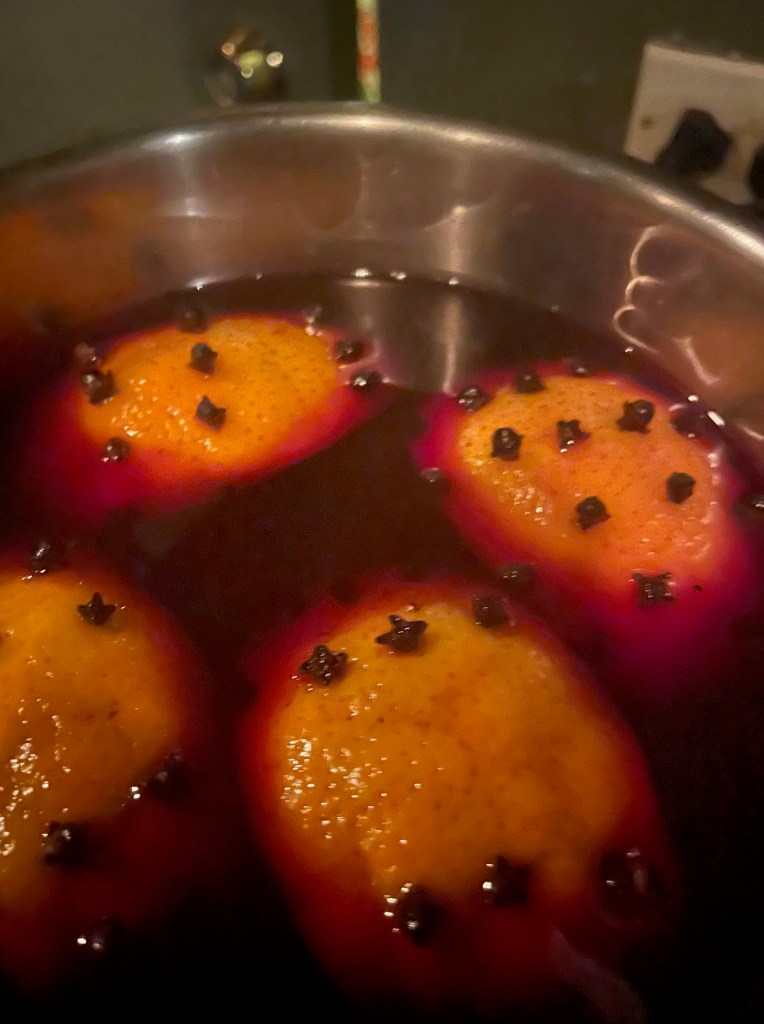
Take an orange, stud it. thickly all over with whole cloves, dip it in cognac and dust with brown sugar. Now brown well until sugar caramels, either spitted upon a skewer or sick before the fire or under the broiler. Cut it into quarters; now take a saucepan or other vessel, turn in 1 qt of red port wine, simmer tightly for 20 minutes, add 2 jiggers of cognac before pouring. can be served flambe with a little brandy floated on top.
Note here from The Aging Bartender: I made this the other night and it was just so-so. Not my thing. I used decent port but it seemed like a lot of work for not much pay off. Also, the brandy float would have to be quite strong in order to ignite on top of this drink which demonstrates the different proof they had in those days compared to our own. Anyway…Let’s continue with Mr. Baker’s next demonstration of an English Bishop:
HOT HELPERS BASED upon Burgundy or Claret or Port Wine
THE ENGLISH BISHOP IS FIRST, & Mentioned under Brandy Drinks just above this Juncture & in the Same Category, Page 54.
NOW WE COME UPON a MATTER of Mulled Claret & Port, together with Cognac, Spices, Peels & other Matters; from a Receipt in the Time of Good Queen Bess, CIRCA 1578
Mix 3 cups of claret and 1 of red port; add 1/2 cup of cognac, the spiral yellow peel of a lemon, and 2 good pinches each of cinnamon and nutmeg. Toss in 1/2 doz whole cloves, cover well and heat hot–but do not boil. Take off immediately it is hot enough to suit taste and not a moment longer, an’ it please you! Boiling ruins port instanter, evaporates all alcohol and leaves a bitter lees calculated to spoil the best ingredients.
So, the basic jist here is simmer some port and red wine together with spices and fortify with cognac.
There’s many variations, but one of the more outlandish among so many, is the Horse Collar, again from 1939’s The Gentlemen’s Companion, this time from a little further down the road on page 58:
NEXT MARCHES the BAKER “HORSE COLLAR,”* Originated by the Author, A.D. 1935, upon running into Stonington, Rhode Island, ahead of a Howling Nor’Easter when Heading South from Lawley’s Yard to Florida in MARMION.
This hotter toddy was invented by the sere and palsied hands, quite through luck and sheer accident. Our 56 foot ketch MARMION having just been discharged with a new and costly main trys’l re-rig from Lawley’s Yard, the split-spirit necessary to spreading that fancy triangular bit of canvas became known as the “Horse Collar.” On the run from Cape Cod to New York, we stuck our noses into a snoring nor’easter, which added up so quickly that we dropped the hook at Stonington, Rhode Island, rather than be shaken up any more than necessary. It was early November and cold as hades. Well that night all hands screamed for hot rum, and we found no lemons in the lazarette–and to many otherwise cultured folk a hot rum without a dash of lemon is like hte Democratic Party without the ghost of Jefferson, Tom without Jerry, a Cuban without his mistress. But we had oranges!–and thereby hangs a tale. For suddenly we thought of orange peel–and orange peel roasted with wild duck and how superbly fragrant it can become. Scarcely daring to hope for anything virtuous coming out of the effort we proceeded as follows.
Tin cups for mariners, silver cups for fancies
Carta de Oro Bacardi, Jamaica, Barbados, or Haitian rum, 2 jiggers
Orange peel, 1 to each cup, cut in unbroken spiral
Brown sugar, 1 tsp per cup
Whole cloves, 6; or powdered clove, 1/4 tsp per cup
Boiling water, enough to fill
Butter, 1/2 tsp, optional
*We here confess (with modest blush) that this Baker Horse Collar has attracted more attention than any other hot one listed between these boards: letters from everywhere: from a placer gold outfit the hell and gone above the Arctic Circle in Alaska to Newara Eyliya, situate high up in mountains in Ceylon; to Quito in Ecuador, New Zealand and the Argentine. Author.
Line cups with spirals of orange peel, first dipping them in rum to moisten. dust sugar on peel, then cloves the same. Put a jigger of rum in each cup, put cups on hot stove, and after a moment set aflame. Let burn until edges of peel start to brown and sugar to caramel. Blow out. Take off stove, add other jigger of rum, fill up with hot water, give a brief stir and serve–either with or without a lump of butter on top the size of a hazelnut. . . . This sounds complicated, but the whole thing takes only a couple of minutes. Cups and rum must be heated or when set alight the moisture in the peel will come out and smother the flame. . . . The Horse Collar thus has four delicious aromatic scents and savours: first the rum itself, then the nut-like perfume of burned oil of orange, then the brown sugar, slightly carameled by the flame, then the toasted spice.
I could keep going, the book is full of such drinks, but I’ll unpack the Horse Collar above, because it’s a bit confusing. It seems as if the tin cups are placed directly on the stove and the heating from below is what causes the flame, a bit like what happens when you put wine in a hot saute pan and it catches fire. When heated, lower proofs that are not navy strength (at least 57.15% alcohol) will burn because they will not ignite at room temp.
So, if I were to replicate this drink, I would perform the same exact procedure but would instead not heat the mugs over an open flame and just use cheap ass 151 for the burn portion and then add good rum afterward once the peels caramelized. It sounds pretty good actually. Not something I’d serve at Rustic but more a good time for home bartending.
I don’t have the time here for more from the book, but there’s another called The Timke Locomotive described as “…A smooth, delicate, gentle, hot reviver, discreet enough for the tenderest maid, the most careful spinster.”
I think during this Christmas break I’ll experiment with a few of these and report back…
 The Aging Bartender
Leave a comment