

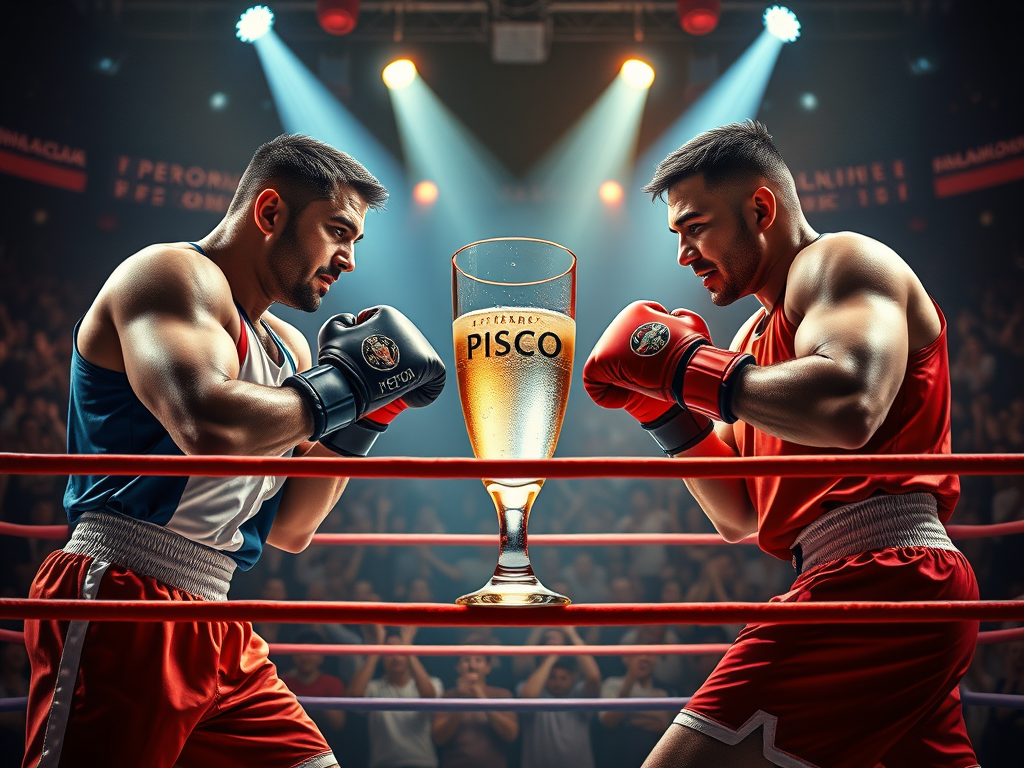
A hot debate rages down in South America between two rival, neighboring countries who have had a long history dating back to The War of the Pacific between them which occurred during the years 1879 to 1884. Since those days, the battlefield has been contested between two modern arenas, the football field and bragging rights over a certain spirit, pisco. Yes, pisco, if you have yet to guess from the title of this post. So, the big question: Who invented pisco first, Peru or Chile? Ask anyone from either respective country and they will tell you they are the true originator of the delicious grape distilled eau de vie/brandy. So? Before we proceed…Number one, who holds claim to the title? And number two, who cares? Read on…
First off, let us define pisco. It counts as eau de vie or brandy which are both fruit spirits. Yes, take any fruit, ferment it, distill it, you initially produce eau de vie, the unaged version of a brandy, French for Water of Life. Put that spirit in a barrel, age it, voila, brandy. The most popular oak barrel aged version would be known to the common punter (you) as cognac, armagnac, etc. Here in the states our oldest distillery is an apple brandy company name of Lairds (my apostrophe button is still broken, sue me). Apple brandy in France is known as Calvados. Yeah, spirits are not as complex as wine obviously, but still have a lot of distinctions and rules as you will come to see.
Grapes arrived in the New World along with the first European conquerors. Peru became a country on July 28, 1821 when they separated from Spain. Chile celebrated their independence from Spain on September 18, 1810. Grapes were cultivated in Peru in the early 1540s whereas Chile followed a little behind by a decade or so in the 1550s. It is said that the Chilean grapes were brought from Peru, which makes some sense, given the geography of the two countries. Chile is due south from Peru, more mountainous and isolated.
According to the great Google AI God, the pisco methods differ wildly between the two, which further separates them. Peru is quite strict. They do not age their pisco in wood at all, only in neutral tanks such as glass or concrete. They distill once and distill to proof. They do not add water at all. They use eight different grape varietals.
Chilean pisco methods, on the other hand, are quite different. They use up to 13 different grape varietals, age their pisco in wood, are allowed to add water, and distill as many times as they choose. This creates an entirely different product from the Peruvian version. It is a bit like the German beer versus American beer methods where Germany is strict as hell and America is loosey goosey.
There are other, more technical differences in the way the grapes are fermented. Differences that make the Chilean and Peruvian differences so different that it makes almost no sense to compare them and in this moment I would love to produce the quote from Jorge Luis Borges when he described the Falklands War 0f 1982, but relate it to Chile and Peru in their respective silly beeves with one another about pisco: Two bald men fighting over a comb…
So pisco in Peru is always an Eau de Vie and Chilean pisco is a brandy that can sometimes be an eau de vie. There you have it. Mic drop. Grapes were cultivated in Peru sooner than in Chile, so it is somewhat obvious that they began distilling sooner as well. Although both versions are called pisco, the two ways they are both produced, and the resulting products, are different. If you want to take it further, UNESCO has recognized Peru as the originator. So if anyone cares…You lose, Chile.

Bonus points for anyone recognizing the above dude and the movie…
Your AI generated image for this post, #440, first of the new year, January 14, 2026
 The Aging Bartender
Leave a comment