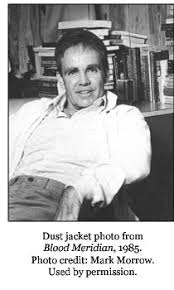
Like the blurb says, the above picture is from the dust jacket photo from Blood Meridian, 1985. It was the first McCarthy book I read. Handed to me by my ex-girlfriend, N. It was one of those deep winter relationships that lasted just until spring. The woman, not the book. You’d have to live in a cold place to understand. “You have to read this,” she said, so I did. Then I read it again. The first go through was difficult. The prose is dense and worded in an odd way, like Melville, or the bible. Almost no punctuation whatsoever. Lots of crazy long sentences and puzzling Germanic and long forgotten words.
The subject of the novel is of the westward expansion, of the slaughter of native peoples living in America, but the theme is war. In McCarthy’s words straight from the book, “Before man was, war waited for him.” To say Blood Meridian made an impression on me would be an understatement. I became a little obsessed with the man and his work afterward. For one, he was a hermit. He didn’t do interviews, or teach, or do any of the things writers did to make a buck. He worked as a mechanic and did other odd, blue collar jobs. He lived for a while in a house with no plumbing. All the while, however, he wrote.
His first four books, especially the semi-autobiographical, Suttree, earned him a MacArthur Fellowship, also known as “The Genius Grant.” $500,000 parceled out over five years. That gave him the opportunity to write Blood Meridian. In his research, he went so far as to actually traverse the same western terrain the characters in his novel travelled and it’s quite apparent in the intense descriptions of the land present in the book which, in a sense, becomes its own character.
Here’s one:
“Bone palings rules the small and dusty purlieus here and death seemed the most prevalent feature of the landscape. Strange fences that the sand and wind had scoured and the sun bleached and cracked like old porcelain with dry brown weather cracks and where no life moved. The corrugated forms of the riders passed jingling across the dry bistre land and across the mud facade of the jacal, the horses trembling, smelling water.”
Here’s another very long one from the beginning of chapter XIV that is absolutely beautiful and weird and full of simile:
All to the north the rain had dragged black tendrils down from the thunderclouds like tracings of lampblack fallen in a beaker and in the night they could hear the drum of rain miles away on the prairie. they ascended through a rocky pass and lightning shaped out the distant shivering mountains and lightning rang the stones about and tufts of blue fire clung to the horses like incandescent elementals that would not be driven off. Soft smelterlights advanced upon the metal of the harness, lights ran blue and liquid on the barrels of the guns. Mad jackhares started and checked in the blue glare and high among those clanging crags jokin roehawks crouched in their feathers or cracked a yellow eye and the thunder underfoot.
They rode for days through the rain and they rode through rain and hail and rain again. In that gray storm light they crossed a flooded plain with the footed shapes of the horses reflected in the water among the clouds and mountains and the riders slumped forward and rightly skeptic of the shimmering cities on the distant shore of that seas whereon they trod miraculous. They climbed up through rolling grasslands where small birds shied away chittering down the wind and a buzzard labored up from among bones with wings that went whoop whoop whoop like a child’s toy swung on a string and in the long red sunset the sheets of water on the plain below them lay like tidepools of primal blood.
They passed through a highland meadow carpeted with wildflowers, acres of golden groundsel and zinnia and deep purple gentian and wild vines of blue morningglory and a vast plain of varied small blooms reaching onward like a gingham print to farthest serried rimlands blue with haze and the adamantine ranges rising out of nothing like the backs of seabeasts in a devonian dawn. It was raining again and they rode slouched under slickers hacked from greasy halfcured hides and so cowled in these primitive skins before the gray and driving rain they looked like wardens of some dim sect sent forth to proselytize among the very beasts of the land. The country before them lay clouded and dark. They rode through the long twilight and the sun set and no moon rose and to the west the mountains shuddered again and again in clattering frames and burned to final darkness and the rain hissed in the blind night land. They went up through the foothills among pine trees and barren rock and they went up through juniper and spruce and the rare great aloes and the rising stalks of the yuccas with their pale blooms silent and unearthly among the evergreens.
Yeah.
I could keep going. Its just so different and well written and when you’re finished you wonder who the hell this guy is and how he did it so well. As I write even this small passage my own writing is influenced by the few paragraphs of his I just read. Just amazing. He gets right into your head.
Seven years later, McCarthy followed Blood Meridian with All the Pretty Horses which won the National Book Critic’s Circle Award and the National Book Award. It’s a love story, a devastatingly sad and beautiful piece of fiction that I reread every couple of years. If Blood Meridian was McCarthy’s ode to historic violence and the inevitability of war then All the Pretty Horses turned more to his tender side, to the beauty of life’s potential. The book is so good that each time I read it it’s like reading it for the first time.
It’s now that I turn to cliche because I don’t really know how to better express how I feel about his death. It’s always that way though. I find it odd to be so affected by the death of someone I don’t know personally but with artists this always happens. We want them to continue with their work, selfishly, forever. But it doesn’t work that way. The art is immortal but not eternal. We must accept what we get from them is finite.


Leave a comment